Hybrid Cloud Migration & Secure Landing Zone Deployment
Introduction
As part of a digital transformation initiative, I led the design and deployment of a hybrid cloud infrastructure for a major enterprise client in the finance sector. The client aimed to migrate critical applications from their on-premises datacenter to Microsoft Azure, leveraging cloud scalability while maintaining robust security and compliance. This project involved a greenfield deployment of a Virtual Data Center (VDC) in Azure, executed in a phased manner to ensure minimal disruption and maximum operational continuity.
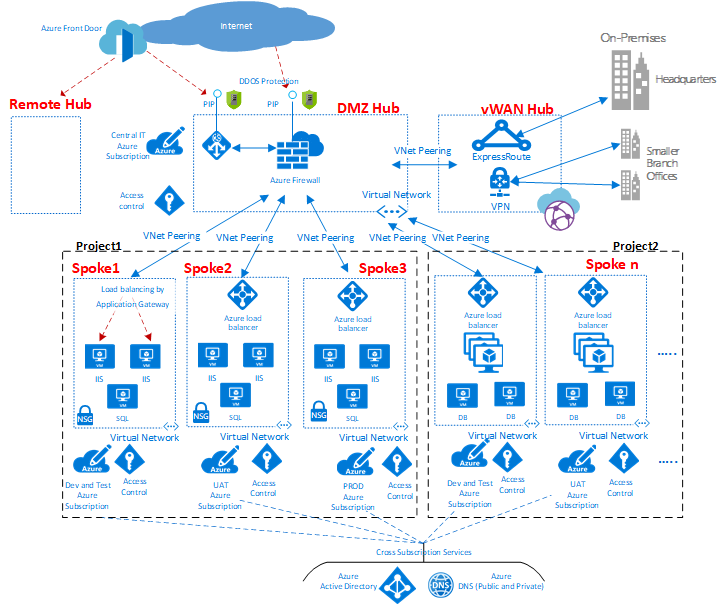
Project Description
The solution architecture centered around a secure, scalable Azure landing zone, designed to support both public and private workloads. The landing zone comprised two distinct Virtual Networks (VNets):
Public VNet (DMZ)
- Hosted a highly available (HA) Cisco Network Virtual Appliance (NVA) for advanced traffic sniffing and logging.
- All inbound and outbound public traffic was routed through the Cisco NVA using User Defined Routes (UDRs).
- The public subnet was configured as a Demilitarized Zone (DMZ), exposing only the Cisco firewall IP to external sources, thereby minimizing the attack surface.
Private VNet
- Dedicated to private traffic originating from the client's on-premises datacenter via a secure VPN tunnel (deployed in East US).
- Traffic was routed through a separate Cisco NVA for comprehensive logging and monitoring.
- Ensured strict network segmentation and compliance with financial industry regulations.
The landing zone was further integrated with additional VNets through peering:
- Active Directory VNet: For centralized authentication and identity management.
- Spoke/Application VNets: Deployed across different subscriptions to host various application workloads, ensuring scalability and isolation.
The Cisco NVAs acted as the central routing and security enforcement points, directing traffic between the DMZ, private network, and application VNets.
Key Components & Technologies
Project Challenges & Solutions
Challenge 1: Security Compliance
Problem: Meeting SOX and PCI-DSS requirements in the cloud
Solution:
- Multi-layer security architecture
- Continuous compliance monitoring
- Automated audit trail generation
Result: 100% compliance audit success
Challenge 2: Application Dependencies
Problem: Complex interdependencies between legacy applications
Solution:
- Detailed dependency mapping
- Phased migration approach
- Parallel running during transition
Result: Zero-downtime migration achieved
Challenge 3: Change Management
Problem: User resistance to cloud migration
Solution:
- Comprehensive training program
- Gradual rollout with feedback loops
- 24/7 support during transition
Result: 95% user satisfaction score